Outcome 01
Boundaries are defined before execution starts.

Systems clarity
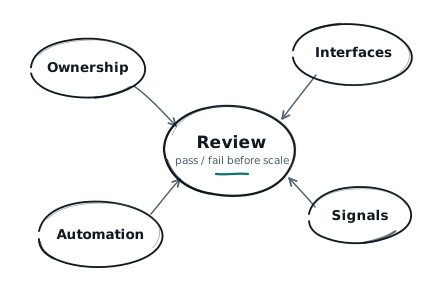
Pume helps teams redesign software, workflows, and information systems so ownership is clear, automation is reviewable, and decisions stand up under pressure.
Outcome 01
Boundaries are defined before execution starts.
Outcome 02
Quality and cost are reviewed on a fixed cadence.
Outcome 03
Decision memory stays visible as the system grows.
Systems
Treat software, operational, information, and interaction layers as one system, not isolated projects.
Define ownership, interfaces, and failure behavior before automation scales.
Keep observability, rollback paths, and auditability in scope from day one.
Use /systems to inspect the full model.
How Pume works
Set explicit constraints and stop-rules before implementation starts.
Ship in small slices with measurable pass/fail checks.
Review cost, reliability, and decisions on a fixed operating cadence.
Use /method to inspect the operating loop.
Technical media workbench
Publishing systems, personal knowledge flows, operator tooling, and automation proof are shaped into public work that can be inspected before it scales.
Field evidence becomes recovery maps, runbooks, and clearer operating questions.
Notes and decision memory feed sharper explanations instead of staying private context.
Status, cost, and control surfaces stay reviewable before they become routine.
Daily radar suggests updates while publishing remains human-reviewed.
From the lab
Pume publishes selected public-safe experiments so people can inspect how systems behave in practice, not just read a summary.
Creative tooling
Pume Studio opens with a logo-object test.
Pume Studio now keeps editable sources, tool lessons, and approved design memory together.
Reporting systems
A report separates evidence from theatre.
One compact structure brings state, evidence, interpretation, cost, and the next decision into the same reading order.
Editorial notation
A TOML fragment replaces another status panel.
A tiny structured specimen carries one thread without turning the Lab into a reporting dashboard.
Contact
Bring a drifting system, a risky automation path, or an experiment that should earn trust before rollout.
concrete system questions
agent experiments worth pressure-testing
partnerships with real operating constraints